Cadence: Designing communication for an unreliable brain-computer signal.
Problem:
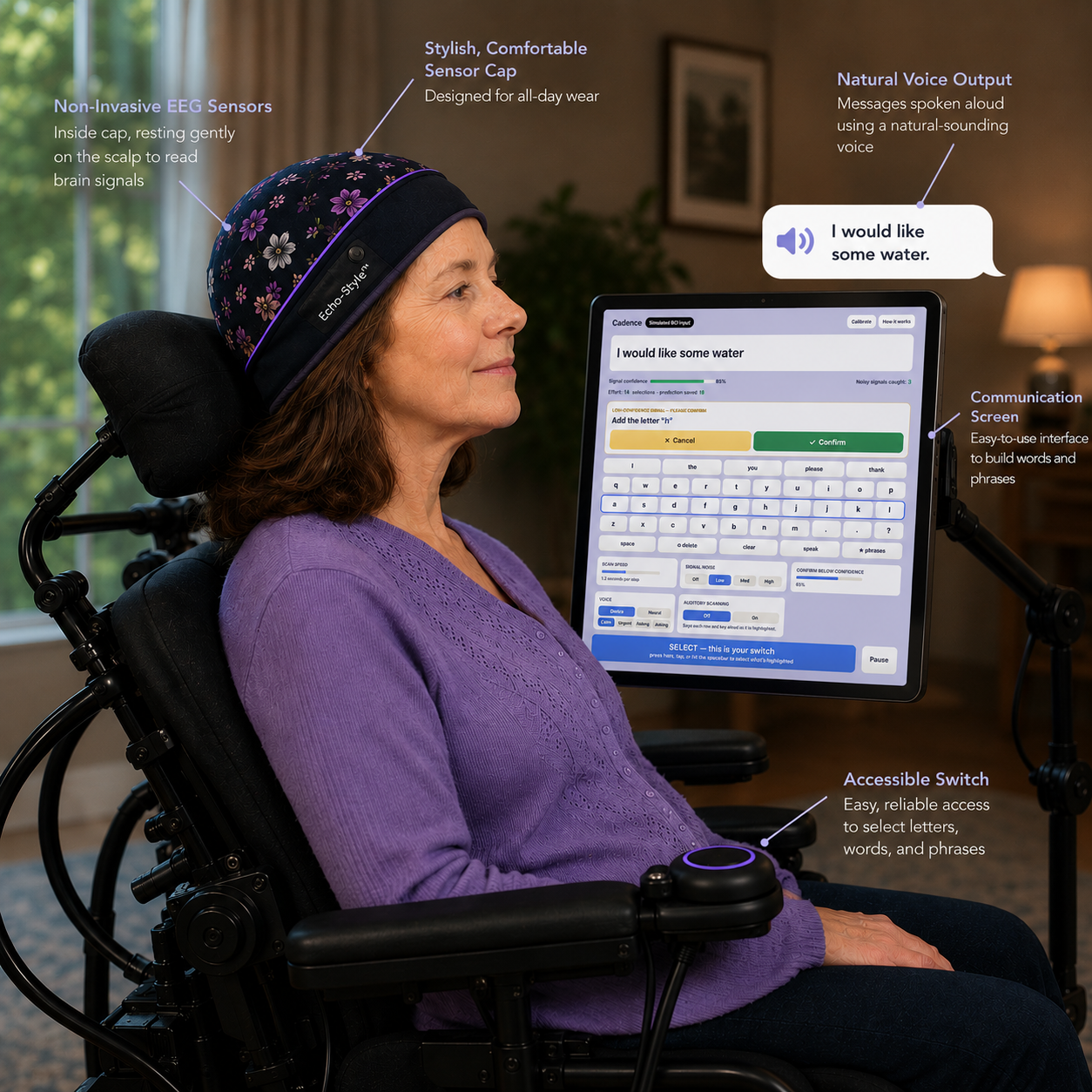
People with severe motor impairment, like late-stage ALS or locked-in syndrome, often can't speak or move but can think clearly. A brain-computer interface can give them a way to communicate, but usually through a single unreliable signal: one slow, effortful "click" that sometimes fires by accident and sometimes misses. Most communication tools were built for a clean, reliable switch, so they treat every click as if the person meant it. With a noisy brain signal, that means a stray blip can land in the middle of a word and there's no efficient way to recover.
Solution:
Cadence is a communication interface that works with a messy brain signal instead of against it. It treats each click as a probability, not a certainty: confident presses go through instantly, but weak or noisy ones pause and ask before committing, so a bad signal won’t corrupt the message. It also takes the output seriously, treating the spoken voice as part of the person's identity rather than a flat robotic voice. The result is a tool that stays fast when the signal is good and cautious when it isn't. Cadence is a personal project based on an interest in the BCI space for disabled individuals who are unable to communicate with their voice.